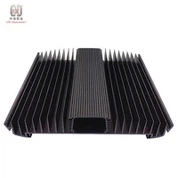
Heat Sink Design
The technology and production process of custom heat sink varies in design, which will affect the heat dissipation effect of the final aluminum profile custom heat sink. Therefore, custom heat sink design is particularly important as the first step in heat sink manufacturing.

- Product Introduction
Heat Sink Design / Thermal Design Engineering
Transforming Heat Challenges into Competitive Advantages
Stop retrofitting thermal solutions - our Heat Sink Design Service engineers performance-driven thermal architectures from concept to production. We deliver bespoke thermal solutions that optimize every variable: material selection, fin geometry, manufacturing process, and system integration. Unlike off-the-shelf compromises, our application-specific thermal design engineering leverages proprietary CFD/FEA simulation and industry expertise to create heat sinks that achieve 20-40% better thermal performance while reducing system costs. Partner with us for integrated thermal management systems where every watt dissipated contributes to your product's reliability and market differentiation.
Product Description

The technology and production process of custom heat sink varies in design, which will affect the heat dissipation effect of the final aluminum profile custom heat sink. Therefore, custom heat sink design is particularly important as the first step in heat sink manufacturing.
As a heat dissipation tool with high heat dissipation efficiency, the aluminum profile custom heat sink is widely used in the electronics, electrical appliances, and lighting industries. Different custom heat sink manufacturers have different technical processes and refer to different production standards. The aluminum profile heat sink will also have good or bad heat dissipation effects. Therefore, to pursue better heat dissipation effect, how to design the custom heat sink?
Design Parameters
Thermal Simulation:
CFD airflow optimization (ANSYS Fluent)
Transient thermal analysis (0.5°C resolution)
Structural Validation:
Vibration modeling (MIL-STD-810G compliance)
Thermal stress FEA
Material Expertise:
6060-T6 to 1070 alloy selection
Thermal interface material optimization
Manufacturing Integration:
Extrusion die design tolerance: ±0.025mm
DFM for casting/extrusion/skiving
Compliance Frameworks:
IEC 60529 (IP ratings)
UL/CE certification pathways

Title

Title
Features
Bottom design of custom heat sink
The fins are usually considered to be the key of heat dissipation. In fact, the heat sink at the bottom is also a part that cannot be ignored in heat dissipation. The bottom design of the custom heat sink should adhere to the principle of gradually thinning from the heat source part to both sides, which is to ensure that the heat absorbed by the heat source part can be quickly transferred to the surrounding thinner parts to achieve high-efficiency heat dissipation.


Fin design of custom heat sink
Designing the heat sink in the shape of fins is not only to increase the contact area with the heat source to absorb more heat, but also to increase the contact area between the heat sink and the air so that the heat can be dissipated into the air faster.
Aluminum extrusion technology
It is obvious that the heat sink has extremely high requirements in shape design and dimensional accuracy. The heat sink must be error-free during the molding process in order to achieve the expected heat dissipation effect. Aluminum extrusion is a part processing method that applies strong pressure to the aluminum alloy material placed in the mold cavity to cause directional deformation of the aluminum alloy, thereby obtaining the required cross-sectional shape, size and certain mechanical properties.

Surface treatment
The effect of ordinary aluminum profile heatsinks on radiation heat dissipation is not good, and anodizing is used to form an oxide film on the surface of aluminum profile heatsinks to enhance the heat radiation ability of the heat sink and make the heat dissipation effect of the heat sink more outstanding.


Design Process
Thermal-Centric Co-Design: Collaborative engineering sessions with your team
Prototype-to-Production Continuity: Identical performance from first sample to volume run
Multi-Physics Optimization: Concurrent thermal/mechanical/EMI simulation
Cost-Driven Architecture: Material/process selection targeting 15-30% cost reduction
Lifecycle Validation: Accelerated testing for 100,000+ hour reliability
Supply Chain Integration: Approved vendor lists for seamless production
IP Protection: Secure data handling with NDA options
Application-Specific Design Solutions
Our thermal design engineering services transform:
EV Power Electronics: 800V SiC inverter cooling with <0.08°C/W
5G mMIMO Antennas: Die-cast enclosures with integrated heat pipes
Medical Laser Systems: Vacuum-brazed microchannel cold plates
Industrial Motor Drives: Vibration-resistant extruded assemblies
Aerospace Avionics: Weight-optimized vapor chamber solutions
Consumer Electronics: Ultra-thin skived designs <1.2mm
LED Grow Lights: Horticulture-optimized spectral reflectivity
Robotics: Conformal cooling for joint actuators
Proven Design Workflow
Phase 1: Requirements Capture
• Thermal load mapping • Environmental constraints • Cost targets
Phase 2: Virtual Prototyping
Multi-physics simulation (thermal/stress/flow)
Material trade-off analysis
Manufacturing process selection
Design FMEA review
Phase 3: Physical Validation
3D printed functional prototypes
Thermal test rig validation
Design refinement loop
Phase 4: Production Transition
Tooling design (extrusion dies/casting molds)
Pilot run process validation
PPAP documentation package
Hot Tags: Heat Sink Design, China, suppliers, manufacturers, factory, customized, wholesale, buy, price, free sample, black anodized heat sink, aluminum extruded heat sink, tailor-made aluminum heat sink, Aluminum Heat Sink, Anodized Aluminum Heatsinks, Custom Aluminum Heat Sink